How to Combine Games With AI: A Practical Modding Workflow
Plan a small AI-assisted game mashup, choose a documented modding route, test a real interaction, and understand the setup and cost before you begin.
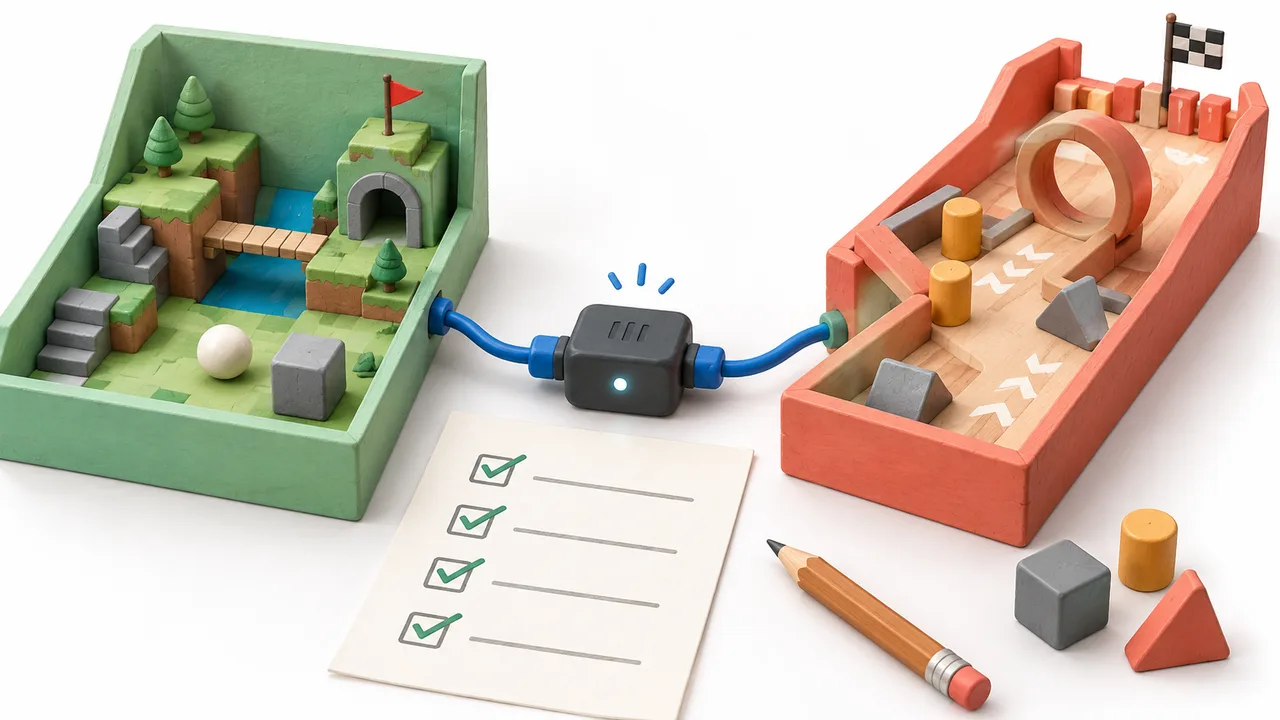
To combine games with AI, define one interaction, find a supported modding route, and test that interaction inside the actual game. A coding agent can help investigate and implement the connection; a prompt is not evidence that the result works. Start smaller than the crossover you eventually want.
This is a planning and validation workflow, not an installation-tested tutorial for every game pair. The linked project documentation was checked on October 16, 2026. If you only want an existing mashup, start with what AI merge games are and how to assess them.
1. Decide what is moving between the games
“Put Game B in Game A” leaves the hard decisions unstated. Do you mean its appearance, movement, objects, level geometry or entire simulation? Those are different jobs.
Write a one-sentence target such as: “In a private test level, pressing a button in my sandbox sends one event to my other prototype and moves a ball.” That is a testable goal. “Merge both entire games and preserve every quest” is not a useful first milestone.
For a commercial-game project, record the host title, contributing title, exact editions and installed versions. For a first experiment, two small projects you control make the inputs and failure cases easier to inspect.
2. Choose a route before generating code
Universal Modder is a public toolkit for AI coding agents, not a finished mashup game. Its README describes discovering the game, choosing a route and verifying changes in a running session. Read the original repository rather than a similarly named download page.
Its mashup skill distinguishes approaches such as transferring content, bridging running games and using an existing implementation as a library. Use that distinction to ask better questions:
- Is there a supported mod API or loader for the host?
- Can the desired behavior be implemented in the host without a second process?
- If two processes are necessary, what is the smallest state they must exchange?
- Is there already a maintained library that implements the movement you want?
For example, libsm64 is an existing movement/rendering library. Using it is a different engineering problem from synchronizing two full running games. Neither route means feeding an entire game installation into a model's context window.
3. Establish a clean baseline
Before changing anything, launch the unmodified game and keep a separate test save. Record the versions and what a normal session looks like. Keep a rollback plan that you can explain without asking the AI to remember its previous conversation.
Use an isolated, supported modding environment. Do not authorize a tool to bypass ownership checks, DRM or protections for competitive online play. The Universal Modder README explicitly draws boundaries around those actions; a broad marketing phrase does not override them.
4. Ask for a feasibility report, not immediate installation
Here is an original planning prompt you can adapt:
I own the games used in this project. I want a small, private modding experiment.

Host game and exact version: [fill in]
Contributing game or my own prototype: [fill in]
One desired interaction: [fill in]
Operating system and hardware: [fill in]

First inspect the maintained documentation and existing examples.
Report the likely route, dependencies, expected file changes, and unknowns.
Do not install loaders, modify my game files, spend on external services,
or publish anything yet. Do not bypass DRM, ownership checks or anti-cheat.

Propose one minimal test with an observable pass condition and rollback.
Separate documented facts from assumptions. Wait for approval of that plan.
This does not make an unsupported pair compatible. It gives you a way to stop before spending hours on an approach whose prerequisites are missing.
5. Build one observable interaction
Avoid beginning with inventory, terrain, combat, saving and multiplayer at once. Choose one path through the system and give it a visible result.
For an event bridge, a useful first test might be: action emitted once, received once, visible change occurs once. Then disconnect a process and check that the host remains usable. After that, test restart behavior so an old event does not unexpectedly replay.
The repository's Minecraft/GTA V example documents game-specific components and communication between them. Study it as a case study, not as a universal command sequence to paste into an unrelated engine.
6. Test more than the showcase moment
Use a small test record with these fields: versions, machine, test action, expected result, observed result, known failure and rollback. Capture the actual session instead of using concept art as proof.
Before calling the experiment playable, check at least startup, the core interaction, failure recovery and a second launch. If saving matters, test a separate save and restore it. If multiplayer matters, test a real second participant; a working invite button is not enough.
For performance, measure the actual combination. Running two simulations can cost more than running either one, but there is no honest universal RAM or FPS requirement for all mashups. A single successful desktop test does not establish phone, Mac or Steam Deck compatibility.
7. Package only what you can distribute
Keep the result separate from the original game installation where the supported tooling allows it. Publish your own code or assets and the appropriate patches, not a bundle of commercial game files. A local experiment is not automatically something you can redistribute.
If you use a publishing platform, review its current creator requirements before submitting. Melty's player and creator paths are different from the open-source toolkit workflow described here.
Is combining games with AI free?
Separate the bill into the games, coding-agent access, optional generation services and your time. A free repository does not make every dependency or model call free. Set a spending limit before a long agent run and ask it to stop at the first working milestone.
Can a beginner make a mashup?
A beginner can investigate a small, documented experiment. That is different from being promised a polished crossover in one prompt. The best first result is a connection you can reproduce and explain, with its limits written down. Expand it only after that result survives another launch.